Intercom alternatives after the Salesforce deal: what to ask
intercom, vendor-evaluation, helpdesk, ai-support
If you run support on Intercom, the honest answer to "should we move?" in August 2026 is: not yet, but start building the evidence now. The deal is signed, not closed, and nothing about the product has changed. What has changed is that you can no longer assume the roadmap you bought into is the roadmap you will get. That is a reason to run a real evaluation on your own schedule — and an evaluation is worth something only if it is done against vendors' documentation rather than their landing pages.
Below are fifteen questions to put to that documentation, grouped by the things that actually hurt after you have migrated. Each one is written so the answer is either on a page you can link to, or conspicuously absent.
What actually happened, and what hasn't
Salesforce signed a definitive agreement to acquire Fin for approximately $3.6 billion on 15 June 2026. Two details get lost in the retelling:
- Fin and Intercom are the same company. Intercom renamed itself Fin in May 2026, before the deal. Coverage that treats them as two products is describing one.
- The deal is signed, not closed. Salesforce expects it to close in its fourth fiscal quarter of 2027, subject to regulatory approval. Until then, nothing is contractually different for you.
Salesforce has said it intends to fold Fin's team and technology into Agentforce (TechCrunch, CNBC). Around 30,000 customer companies come with it, most of them SMB and mid-market (Salesforce Ben).
Why mid-market should still start looking
Nothing here predicts that the product gets worse. The predictable part is narrower and duller: an acquired roadmap gets re-pointed at the buyer's data model and the buyer's largest accounts. If your company is a 40-seat support team, you were a priority segment for a standalone Intercom in a way you are unlikely to be for a $3.6bn line item inside Agentforce.
The cost of being wrong is asymmetric. If you evaluate now and stay, you have spent a few weeks and learned what your alternatives actually cost. If you skip it and the roadmap moves, you will be choosing a replacement under time pressure, which is when teams buy on the landing page.
The mistake: choosing from a listicle
Search "Intercom alternatives" and you get lists of thirteen tools with a feature-comparison table. Those tables are assembled from marketing pages, and marketing pages are the one artifact a vendor can change on a Tuesday afternoon with no consequences. Documentation is different: it is written for people who have already paid, it contains the caveats, and it is the closest thing to a commitment a vendor makes in public.
So the question is not "which of these thirteen is best". It is "what does each vendor's own documentation commit to, and where does it go quiet".
Three answers a page of documentation can give you
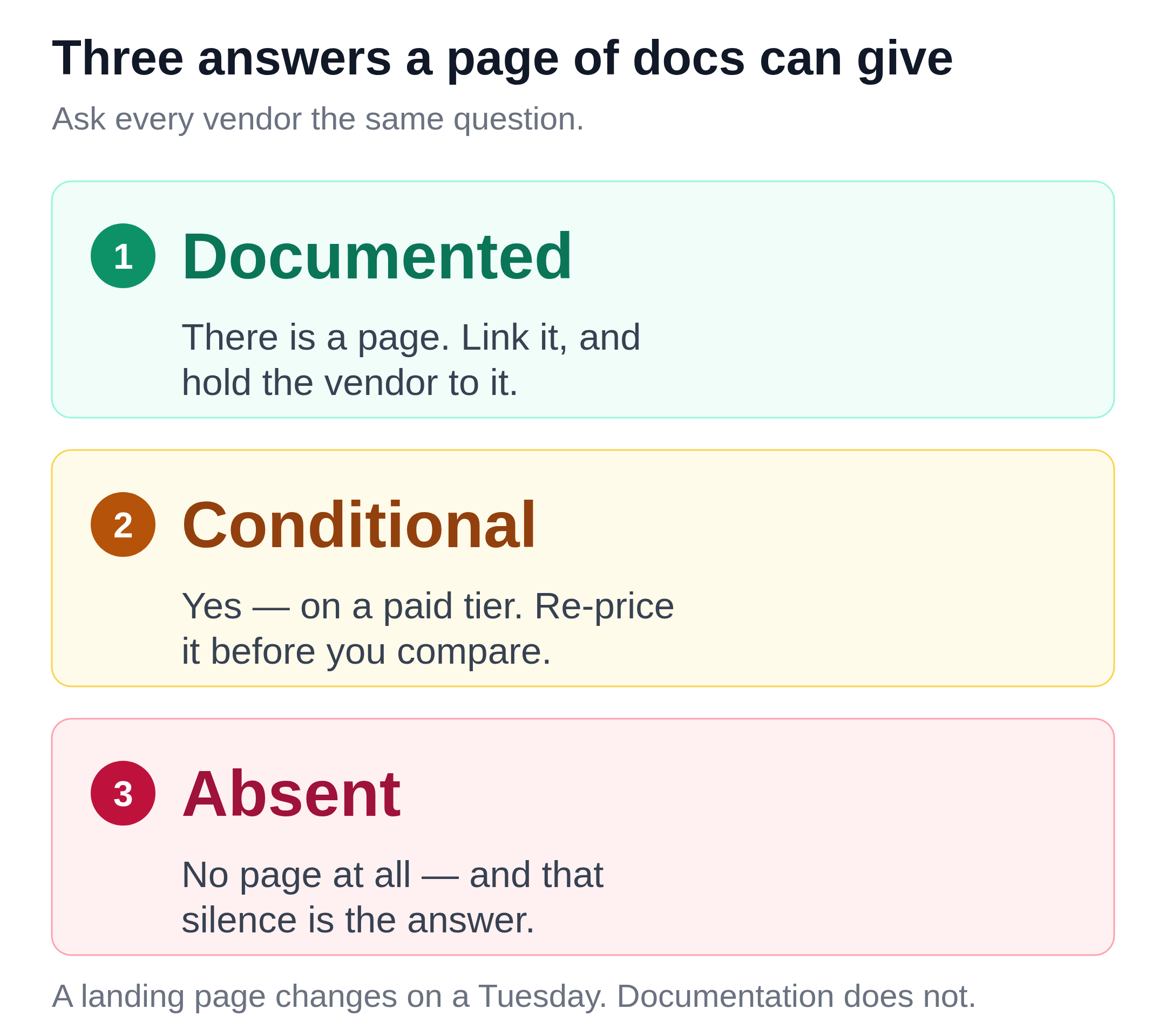
The third case is the one worth training yourself to notice. A vendor with no page about data residency does not have an undocumented data-residency story; it has no data-residency story. Absence is an answer, and it is the answer sales calls are designed to talk you out of hearing.
The fifteen questions
Pricing: what exactly are you buying a unit of?
1. What is the billable unit, and who decides it happened? Per-seat pricing is boring and predictable. Outcome pricing is neither, and the definition of the outcome is where the money is. Fin bills $0.99 per resolution with a 50-resolution monthly minimum, and a resolution is either confirmed (the customer says the answer helped) or assumed — the customer went quiet for 24 hours after Fin's last reply (Fin pricing: outcomes). A customer who read the reply and gave up in silence bills the same as one who was helped.
2. What reverses a charge, and how would you notice? In Fin's model a resolution is refunded if the customer reopens the conversation later. That is a genuinely fair rule, and it is also invisible unless you reconcile the invoice against your own conversation data. Ask any outcome-priced vendor what the reversal rules are and whether the reconciliation is exportable.
3. What happens to unused capacity? Credits, resolution bundles and overage rates all have an expiry policy, and it is almost never in your favour. Chatwoot's Captain, for example, comes with a monthly credit allowance by plan, with overage sold in blocks and non-refundable (Chatwoot pricing).
What the AI counts as success
4. Is "resolution" the vendor's metric or yours? If the vendor's revenue is a function of the same number they report to you as quality, you need your own definition alongside theirs. Write yours down before the demo.
5. Can you audit individual outcomes? Not a dashboard percentage — a list of conversations, each with the outcome the vendor assigned and the reason. If that export does not exist, the quality number is not checkable.
Calling your own APIs
This is the group where documentation quality varies most, and where a thin answer costs you a security review later.
6. How does the AI address your endpoint? The safe pattern is that an administrator registers the operation and its URL, and the model supplies only parameter values. If the model can produce a URL, a prompt injection can point it somewhere else.
7. Where do credentials live? They must be stored server-side and never enter the model's context.
8. What stops the integration being used as an SSRF proxy? Chatwoot's Captain documentation is
the reference answer here, in the sense that it is written down at all: endpoints must use HTTPS,
requests to private IP ranges, localhost and .local domains are blocked, HTTP redirects are not
followed, responses are capped at 1 MB, and there is a 30-second timeout
(custom tools setup guide).
Ask a competing vendor the same four things. If the answer arrives from a salesperson rather than a
page, treat that as the answer.
9. How does your backend know the customer is who they claim? Chatwoot passes an
X-Chatwoot-Contact-Inbox-Verified header, and its documentation tells integrators to check it
before returning order or billing data. Whatever the mechanism is called, you need one — otherwise
"what's my last order" answered by an AI agent is an account-enumeration endpoint with a friendly
tone.
Deployment and where the data goes
10. Is self-hosting real, and what does it cost in features? "Open source" and "you can run the useful version yourself" are different claims. Chatwoot's Community edition is MIT-licensed and free, and Captain — the AI agent — is not in it; it requires a paid self-hosted tier (enabling Captain on self-hosted). That is a defensible business model and a perfectly reasonable answer. It is also exactly the detail a comparison table renders as a green tick under "Self-hosted".
11. Where does inference physically happen? A vendor can be GDPR-compliant in every formal sense and still send prompts to a model hosted outside the EU. Since the EU AI Act's transparency obligations came into application on 2 August 2026, this question also has a compliance edge, not just a procurement one. Ask for the region, the model provider, and whether either can be pinned.
Real-time, channels and language
12. Is there a documented real-time API, or only webhooks? Webhooks tell you what happened. A real-time API lets you build the thing customers notice: live agent presence, typing, instant handover. Crisp publishes an RTM API reference alongside its REST docs and marks breaking changes explicitly in its changelog — that combination is rarer than it should be.
13. How does multilingual retrieval actually work? There is a large difference between "we support 45 languages" (the model translates on the way out, and retrieval still happens against English content) and language-aware retrieval over content maintained per language. The first one degrades quietly, and it degrades in the languages you are least equipped to spot-check.
Getting out
14. What is exportable, and in what shape? Conversations, contacts, the knowledge base, attachments, and the mapping between them. An export that loses which article resolved which conversation loses the only training data your next vendor would want.
15. Can you keep your URLs? If the vendor hosts your help centre, its article URLs carry whatever search ranking you have accumulated. Ask whether you can serve the knowledge base on your own domain, and whether redirects survive a migration. Teams discover this one after the traffic drops.
Where to start reading, per vendor
Documentation quality is itself a signal, so this table is a starting point rather than a verdict. Everything below was read in August 2026; check the pages yourself, because the whole point is not to take a comparison table's word for it.
| Vendor | Where their documentation is unusually strong |
|---|---|
| Chatwoot | An architecture guide, three separate APIs, and the security section quoted above |
| Crisp | The real-time API, and an explicit breaking-changes discipline |
| Plain | Engineering-dense changelog entries that explain how, not just what |
| Pylon | Product docs; the AI agent's custom actions and MCP connections |
| Fin | The widest API surface of the group, and the clearest pricing-mechanics help centre |
What documentation will never tell you
Four things stay unknown until you run a pilot with your own content and your own customers:
- Deflection on your material. Every vendor's number was measured on somebody else's knowledge base. Yours is the only one that predicts anything.
- Quality in your second language, judged by someone who speaks it.
- What support answers at 2am, which you find out by opening a ticket during the trial.
- How much of the migration is manual. The export exists; whether the import maps cleanly is a different question, and one afternoon of trying answers it.
Budget for a pilot that produces those four answers. It is the part of the evaluation that a document cannot replace, and it is why starting now — while nothing is on fire — is worth more than a better spreadsheet later.
Now ask us the same questions
We build Replium, so we have an obvious interest in how your evaluation goes. That is exactly why we should answer first. A method published by a vendor who then ducks it is marketing, and you would be right to read it that way.
Here is where we stand in August 2026, in the same three shapes as the figure above.
| Question | Replium today |
|---|---|
| AI agent, resolutions, deflection | Absent. No model provider is connected and no agent ships. If automated resolution is what you are shopping for, we are not on your list, and no positioning changes that. |
| Live chat, shared inbox, knowledge base | Shipped. A widget for your site, an inbox for your team, and a knowledge base that is server-rendered, so it is readable by crawlers rather than only by browsers. |
| Billable unit, and who decides it happened | Absent — there is no billing in the product. Nothing to reconcile, and no promise about what it will cost when there is. |
| Multilingual | Partial. English and Russian, with search that respects the workspace's language. The other three languages are intent, not product. |
| Self-hosting, data residency | Absent. Hosted by us, one region. |
| Export | Absent. Question 14 is the one we answer worst: there is no export yet. Ask us again before you would need it, not after. |
What a small vendor is actually worth
Five absences in a row is not a sales table, and pretending otherwise would waste the eleven minutes you just spent reading. The honest pitch is narrower.
Everything above is a disadvantage of being small except one thing, and that one is distance. A request you make does not join a queue behind thirty thousand other accounts and a roadmap that now answers to an acquirer. It reaches the people who write the code, and if it is small and sensible it tends to ship in days. That is the entire trade, and it is a good trade for exactly one kind of team: one that needs chat, an inbox and a knowledge base working properly this quarter, and would rather have a vendor who answers than a feature list that does not fit anyway.
It is a bad trade if you need an AI agent now. In that case use the fifteen questions on somebody else, which is what they were written for.
If the trade sounds right, start a workspace — it takes an email, and with no billing there is nothing to cancel. Then tell us what is missing. Being told is the part we are fast at, and right now it is the part that decides what gets built.